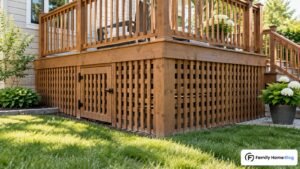
Good deck railing ideas balance three things: keeping people safe at the edge of a raised platform, holding up to weather, and looking like it belongs on your house. Wood, metal, aluminum, composite, cable and glass all handle the safety part if you follow code, but they differ a lot on cost, upkeep and how much they block your view. This guide compares the five main options side by side, walks through the height and opening rules building departments actually check, and breaks down what a typical railing run costs in 2026 so you can plan a budget before you call a contractor or pull a permit.
Deck railing ideas compared: wood, metal, composite, cable and glass
This roundup of deck railing ideas focuses on the five materials builders actually use in 2026. If you are also picking decking boards to match, our composite decking boards guide and our eco-friendly decking materials post cover the surface material in more depth. The table below lines up looks, upkeep, view and code notes for each option.
| Material | Typical look | Maintenance | View / openness | Cost and code notes |
|---|---|---|---|---|
| Wood | Traditional, warm tone | Periodic sanding, staining or sealing | Balusters block more of the view than cable or glass | Usually the lowest material cost of the five, but factor in refinishing over the life of the deck; must meet the same guard height and post/anchor rules as any other material (AWC DCA6) |
| Metal / aluminum | Modern, slim profiles, wide color range | Low; occasional rinse | Slim balusters or horizontal bars keep sightlines fairly open | Mid-range cost; powder-coated aluminum resists rust better than uncoated steel |
| Composite | Matches composite decking, no staining or sealing needed (Trex, railing product page) | Very low | Similar to wood, depends on baluster spacing chosen | Mid-to-high cost; manufacturer warranties for composite and metal railing lines commonly range from 15 to 50 years depending on the series (Trex) |
| Cable | Slim horizontal stainless or galvanized cables | Periodic re-tensioning and cleaning to prevent corrosion (Angi) | Very open; second only to glass | $75 to $260 per linear foot installed (Angi, cable railing cost guide, 2026); local codes set exact cable spacing and tension rules |
| Glass | Clear or frosted panels, minimalist and modern | Frequent cleaning for fingerprints and water spots | Best unobstructed view of the group | Highest material cost of the five; safety glazing rules often require a protective bar about 36 inches, plus or minus 2 inches, above the deck surface if the glass sits within 18 inches of a walking surface (AWC DCA6) |
How much does deck railing cost?
Railing is usually one of the pricier line items on a deck project, right behind the decking boards themselves. Cable railing, one of the better-documented options, runs $75 to $260 per linear foot installed, which puts a 50-foot railing run at roughly $3,750 to $13,000 in materials and labor combined (Angi’s cable railing cost guide, updated July 2026). Labor alone typically adds $20 to $50 per linear foot, or $50 to $100 per hour if your contractor bills hourly (Angi, 2026).
Material choice inside a cable system also moves the price. Galvanized carbon steel cable runs about $0.35 to $0.45 per linear foot, while stainless steel wire costs $0.50 to $1.70 per linear foot (Angi, 2026). Posts range from $20 to $120 for wood, $65 to $125 for aluminum, and $110 to $230 for stainless steel, depending on shape and finish (Angi, 2026). Handrail material itself adds $10 to $20 per linear foot for vinyl or composite, $20 per linear foot for stainless steel, and $30 to $60 per linear foot for aluminum or wood (Angi, 2026).
Zoom out and a full deck build, decking plus railing plus footings, typically lands between $4,340 and $12,652 (Angi’s deck cost guide, updated August 2026). Adding a staircase to reach the yard runs another $25 to $50 per stair (Angi, 2026). Skipping railing repairs rarely saves money either: fixing damaged boards or railing later commonly costs $800 to $3,500, more than a single stair repair alone (Angi, 2026).
Deck railing height and code requirements
Building departments check three numbers on any deck railing: the trigger height, the guard height and the opening size. Under the International Residential Code, a deck floor more than 30 inches above grade requires a guard, commonly cited as IRC Section R312.1 (American Wood Council, DCA6 prescriptive deck construction guide, based on the 2015 IRC). The same guide references a 36-inch guard height in its hold-down anchor and safety glazing specifications, and ties guard posts to a minimum nominal 4×4 size with an adjusted bending design value of at least 1,100 psi, attached to rim joists that are at least a nominal 2×8 (AWC DCA6).
Hold-down anchors, the hardware that keeps a guard post from pulling away from the deck frame under load, need a minimum allowable tension rating of 1,800 pounds at a 36-inch guard height (AWC DCA6). For stairs, IRC Section R311.7.8.1 sets handrail height between 34 and 38 inches, measured vertically from the sloped plane running along the tread nosing (AWC DCA6).
Codes also limit how far apart balusters, cables or mesh openings can sit, so a small child cannot slip through or climb the railing like a ladder. The exact spacing rule varies with the code edition your city or county has adopted, and many jurisdictions amend the base IRC language, so confirm the current number with your local building department before you order materials. If your yard also needs grade support near the deck footings, our retaining wall installation guide covers that adjacent piece of the project.
When to call a licensed professional
Hire a licensed deck builder or structural contractor if your ledger board attaches to the house, if the deck sits well above grade, or if you are unsure how to size footings for your soil and frost depth. A building permit is standard for most new decks and railing replacements, and skipping it can complicate a future home sale or an insurance claim.
How to plan and install deck railing
Installing railing is usually the last framing task before boards and finish work. None of the steps below substitute for your local code; they describe the general order most crews follow.
Step 1: Confirm your code and permit requirements
Call your local building department or check its website for the current adopted code edition before you buy a single post. Ask specifically about guard height, opening spacing and whether the project needs an inspection at the framing stage.
Step 2: Measure and plan your layout
Measure the full perimeter that needs a guard, mark post locations no farther apart than the material manufacturer’s stated maximum spacing (glass panel systems generally need closer post spacing than wood, metal or composite), and plan extra blocking at stairs and corners.
Step 3: Set and anchor the posts
Attach guard posts to the rim joist or blocking with hardware rated to the tension load your code requires, commonly at least 1,800 pounds for a 36-inch guard (AWC DCA6). Undersized lag screws or missing blocking cause the most failures at this step, so follow the hardware manufacturer’s fastening schedule exactly.
Step 4: Install rails, infill and hardware
Add top and bottom rails, then fill in with balusters, cable, mesh or glass panels, keeping spacing inside your code’s limit. Cable systems need a final tensioning pass with a turnbuckle or tensioner once every run is in place, and manufacturers recommend rechecking tension after the first year as the framing settles.
Common deck railing mistakes to avoid
- Skipping the permit. Many jurisdictions require a permit and inspection for new or replaced railing, and unpermitted work can surface as a problem during a home sale.
- Undersized posts or anchors. A nominal 4×4 post with hardware rated below roughly 1,800 pounds of tension will not meet the load AWC’s prescriptive guide assumes for a 36-inch guard (AWC DCA6).
- Guessing at opening spacing. Balusters, cable runs and mesh openings spaced too far apart fail inspection and, more importantly, are not safe for young children.
- Mixing incompatible metals. Stainless cable against uncoated steel hardware can corrode faster through galvanic reaction, so match fastener and cable materials.
- Forgetting to re-tension cable. New wood framing shrinks as it dries, which loosens cable railing within the first year if nobody rechecks it (Angi, cable railing cost guide, 2026).
Which deck railing material is easiest to install?
Aluminum and composite railing kits are generally the fastest to install, since most ship pre-cut with post sleeves and snap-together brackets, so a comfortable DIYer can often finish a straight run in a weekend. Wood is the most forgiving material for a first-time builder to cut and adjust on site, because mistakes are cheap to fix with another piece of lumber. Cable and glass systems take longer: cable needs careful drilling and a final tensioning pass, and glass panels are heavy and need exact opening tolerances. Many homeowners hire a pro for those two even when they DIY the rest of the deck.
What is the best deck railing for your home?
There is no single best pick among these deck railing ideas that fits every home; the right choice depends on your view, your climate and how much upkeep you want to take on. Choose glass or cable if the deck looks out over a yard, water or a view you want unobstructed. Choose wood or mesh if you want more privacy from neighbors, or a warmer, traditional look that matches an existing porch. Composite and aluminum split the difference: both come in colors that mimic wood or go fully modern, and neither needs the sanding and restaining that wood eventually requires. Metal railing also pairs naturally with wrought iron patio furniture if you want a cohesive look across the whole deck, and matching your railing material to your decking keeps the structure looking intentional instead of pieced together.
Quick answers
Does adding railing increase a deck’s value?
Yes, code-compliant railing protects the investment in the rest of your deck by keeping it safe and usable, and buyers notice materials that look intentional rather than mismatched. Composite or metal railing that matches your decking tends to read as a finished, higher-value project compared to bare or ad hoc guardrails, though the exact resale impact depends on your local market and the rest of the deck’s condition (Angi, deck cost guide, 2026).
Do cable railings sag over time?
Not if they are installed and tensioned correctly. Manufacturers design cable railing to resist sagging, and proper tensioning during installation keeps individual cables tight for years, though wood framing settling in the first year can loosen a system enough to need one re-tensioning pass (Angi, cable railing cost guide, 2026).
What is the lifespan of cable railing?
With routine cleaning and occasional re-tensioning, cable railing can last multiple decades, according to Angi’s cable railing cost guide (2026). Stainless steel components resist corrosion better than galvanized carbon steel, which is one reason stainless costs more per linear foot up front.
Can deck railing be curved to match a rounded deck?
Yes, several manufacturers offer curved railing sections for rounded decks and wraparound porches, in materials including composite and metal. Curved runs typically cost more than straight sections because they need custom-bent rail and matching post spacing, so ask your supplier for a curved-specific quote rather than pricing it as standard linear footage.
Of all the deck railing ideas in this guide, the right one for you comes down to matching upkeep tolerance and budget to how you actually use the space. If you want low-maintenance weekends, composite or aluminum earns back its higher price over years of skipped staining and resealing. If the view is the whole point of the deck, cable or glass is worth the extra cost per linear foot. Whatever you choose, call your local building department before you order materials, confirm the current guard height and opening rules for your address, and pull a permit if one is required. If you are planning other exterior upgrades this season, our guide to upgrading your property with fencing covers the yard-perimeter side of the project.