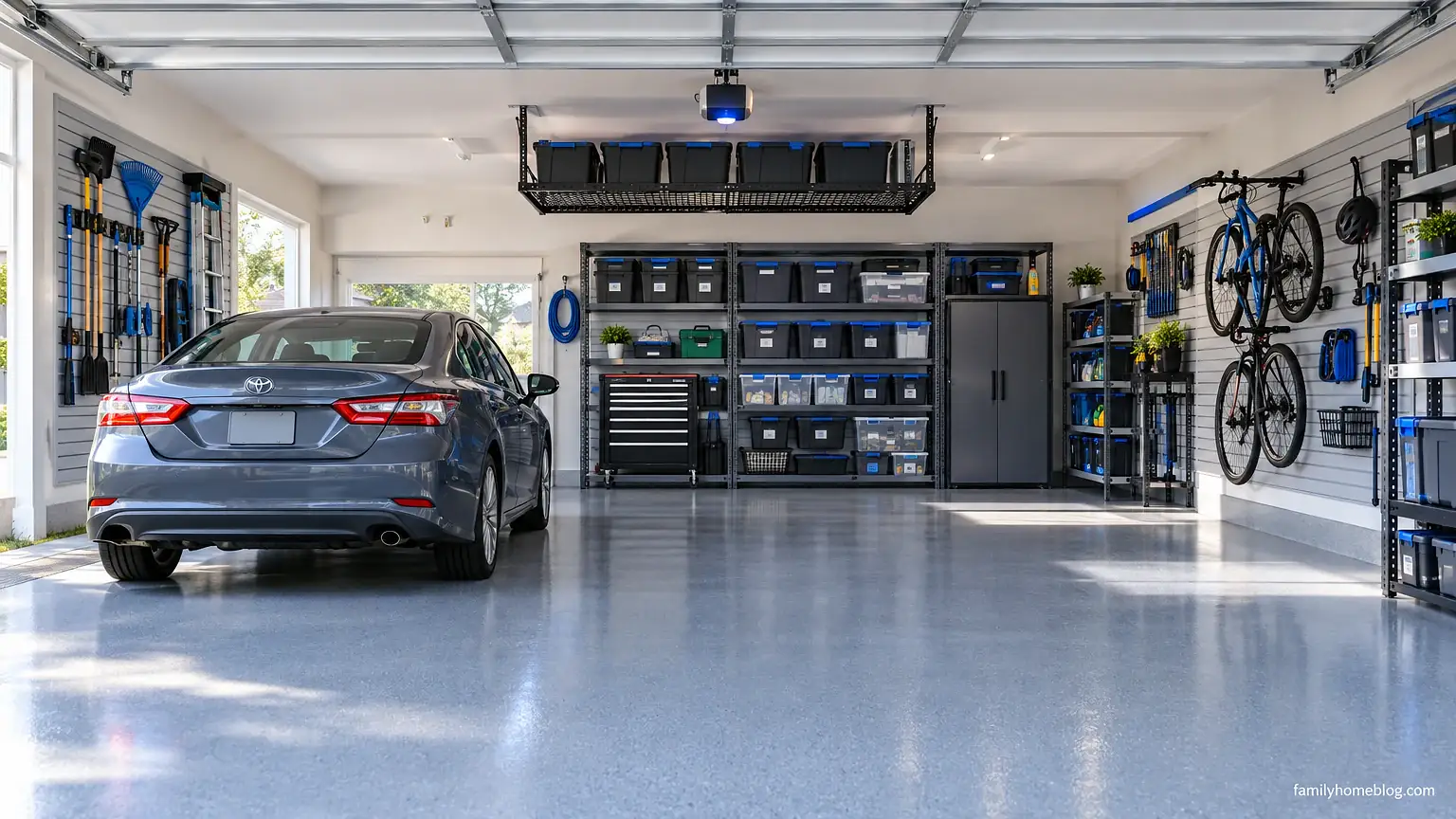
Is a bigger garage the answer to clutter? Almost never. Most cluttered garages have plenty of volume and no system, so stuff piles up on the floor where it blocks the car and hides the tools you need.
Good garage organization starts with measurements, not shopping. Before you buy a single bin, read the guide on organizing your space, then work through the zones below in order.
Measure the garage before you buy anything
Grab a tape measure and a pencil. Record the interior width, depth, and ceiling height at the lowest point. A standard two-car garage often runs about 20 by 20 feet, or 400 sq ft, but older builds are tighter.
Next, note what eats your clearance. Door tracks, the opener rail, and the swing arc of a side door all claim space. Mark the door panel path on your sketch, because ceiling storage must stay clear of it.
Then set the car rule. A parked sedan needs roughly 3 feet of walkway beside it to open a door without dinging the wall. Anything less and your shelving will get scraped.
Finally, ask whether you rent or own. Renters should favor freestanding shelving and over-the-door hooks. Owners can mount into studs without worrying about the deposit.
Sort first, then sort again
Shelves do not fix too much stuff. Pull everything onto the driveway on a dry day and sort into four piles: keep, donate, trash, and relocate to the house.
Be strict with chemicals. Old paint, solvents, and pesticides should not sit in a garage that swings between freezing and 100 degrees F. Check your county’s household hazardous waste program for drop-off days, since rules vary by municipality.
Use a simple decision rule for the keep pile. If you have not touched an item in 12 months and it is not seasonal, it leaves. Seasonal gear gets a labeled bin and a spot in the overhead zone.
Build zones around how you actually use the space
Group by activity, not by item type. A zone is a footprint with one job, such as lawn care, car care, sports, or a workbench. Keep the zone you use weekly nearest the door.
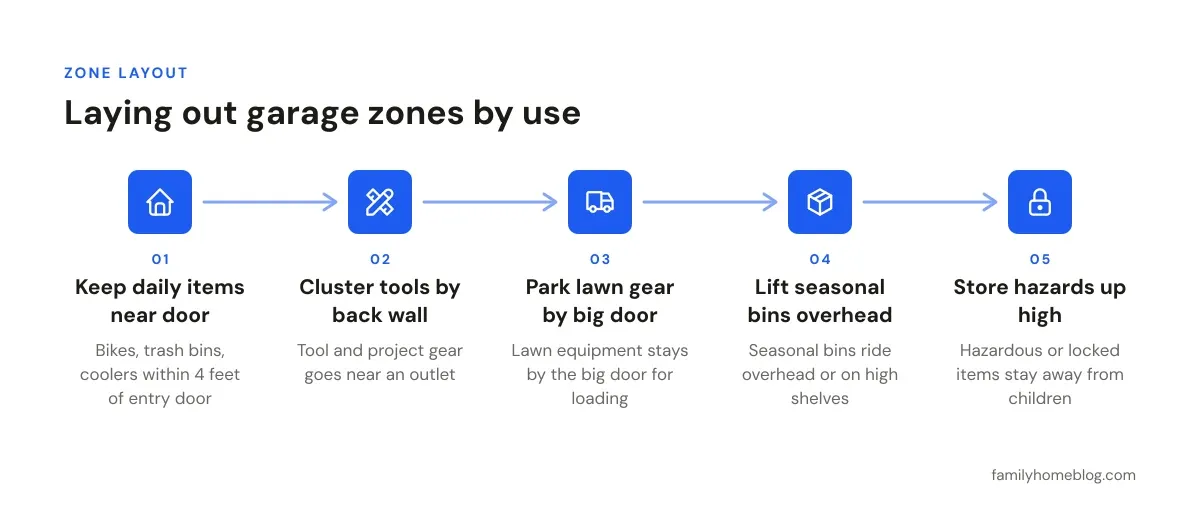
Here is a workable layout for a two-car garage:
- Daily-use items (bikes, trash bins, coolers) sit within 4 feet of the entry door.
- Tool and project gear clusters along the back wall near an outlet.
- Lawn and garden equipment stays by the big door for easy loading.
- Seasonal bins ride overhead or on high shelves.
- Hazardous or locked items go up high, away from children.
Draw this on your sketch before you hang anything. Moving a line on paper costs nothing, while moving a mounted rail leaves holes.
Wall storage that stays put
Walls give you the best return, but only if the fasteners hit solid wood. Wall studs in most US homes sit 16 inches apart on center, and some sit at 24. Use a stud finder and mark each one before you drill.
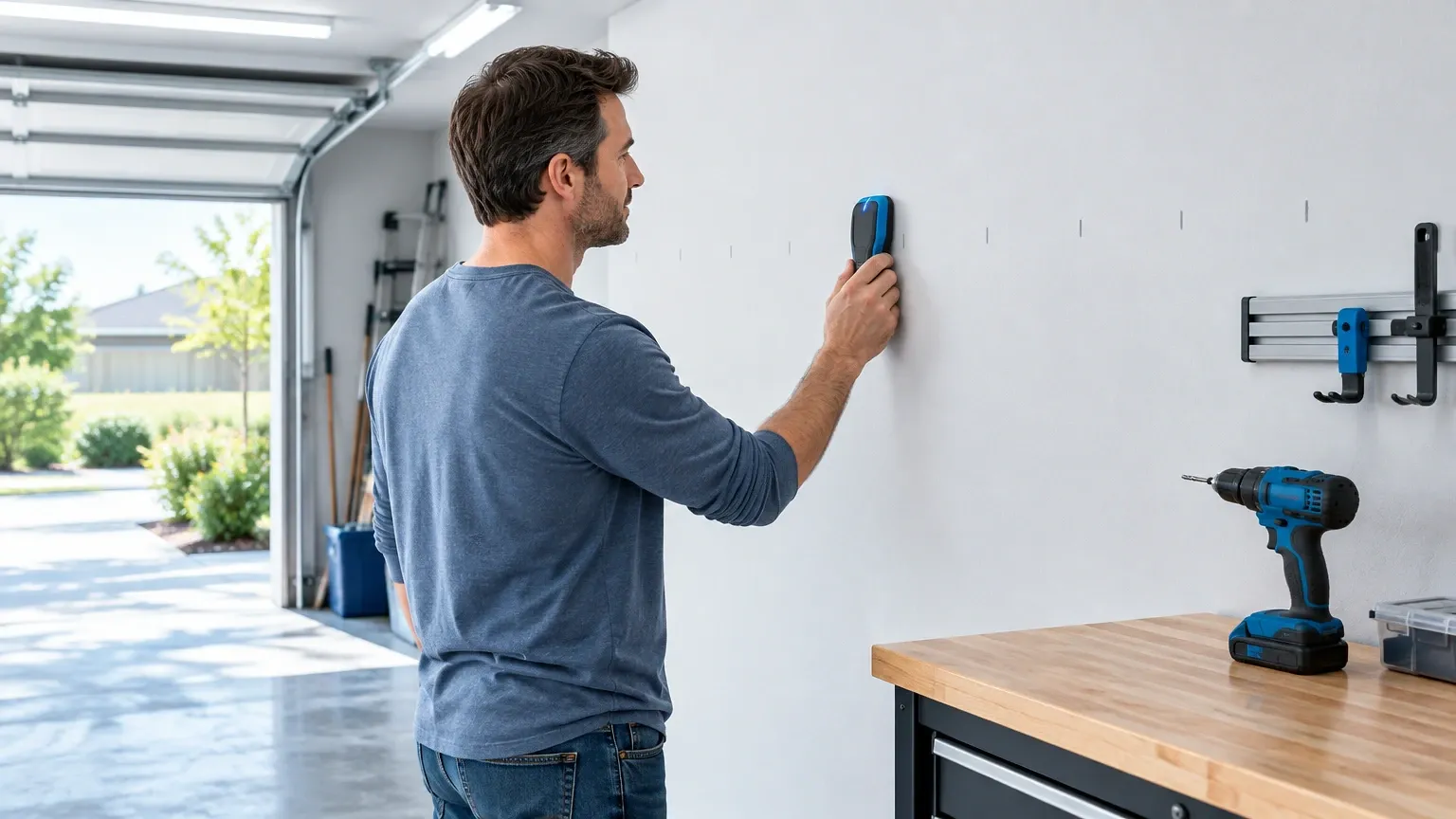
Drywall anchors alone are the classic failure. A shelf of paint cans can weigh well over 100 pounds, and a toggle in bare drywall will let go without warning. Screw a ledger or rail into at least two studs, using lag screws long enough to bite about 1.5 inches into the framing.
Check the manufacturer’s load rating for every rail and hook, and stay under it. Slatwall and track systems list a per-hook limit, often far below the rating of the full panel.
Pegboard works for light hand tools but sags under heavy loads. If you want a wall system for garage tool organization, choose a rail type, then buy hooks that match your heaviest tool.
Floor storage and shelving: what fails and why
Freestanding units are the renter-friendly route. Look for steel shelving with a posted load rating per shelf, commonly 200 to 800 pounds depending on gauge and shelf depth. Always put the heaviest items on the lowest shelf.
Overloaded particleboard bows within months. Humid regions make it worse, because moisture swells the board. In damp climates such as the Gulf Coast, choose steel, plastic, or sealed wood, and lift everything a few inches off a concrete slab that wicks moisture.
Closed cabinets beat open shelves for dust and for hiding visual clutter. They cost more up front. They also fail when doors are left open, so pick doors you will actually close.
Renter note: freestanding steel shelves, wheeled carts, and over-the-door hooks leave no wall damage and move with you.
Overhead storage and ceiling safety
Ceiling racks reclaim dead space above the car hood. Most sit 18 to 24 inches below the joists, which keeps them clear of a standard opener.
Mounting here is a safety matter. Racks must be lagged into ceiling joists, not drywall, and the joists must be sound. A typical 4 by 8 foot rack carries a stated capacity, often about 450 to 600 pounds, so confirm it from the maker’s documentation.
Measure your door’s open position first. Leave at least 2 inches of clearance above the raised door and its track. If joist spacing, rot, or a finished ceiling leaves you unsure, hire a licensed contractor or a structural pro, because a falling rack can injure someone and damage a car.
Keep the system alive
Even a great setup fails if it needs daily discipline. The fix is to make the right action the easy one. Put a labeled home within arm’s reach of where each item gets used.
Use clear bins or large labels on the front, not the lid. You should read a label from 6 feet away. Keep a donate box by the door and empty it monthly.
Schedule two resets a year, such as spring and fall. Pull out seasonal gear, check bins for pests or moisture, and recheck mounted loads. If you also tackle the kitchen, sink organizer solutions follow the same zone logic.
Your next step this weekend
Start small and measure first. Pick one zone, sketch it, find the studs, and clear that footprint before you spend a dollar. A finished corner motivates the rest.
Good garage organization is a set of small decisions made in the right order: measure, purge, zone, mount safely, then maintain. Skip a step and the clutter returns.
Plan on a single weekend for the sort and a second for installing. Prices for shelving and racks vary by region and material, so compare a few suppliers. Then park the car inside and see what you gained.
Frequently asked questions
How much space do I need around a parked car?
Plan for about 3 feet on the driver’s side and at least 2 feet on the other, so doors open without hitting shelves. Tight garages can use shallow, 12-inch-deep wall shelves to protect that gap.
What is the cheapest way to start organizing a garage?
Purge first, since it costs nothing. Then add a few stud-mounted hooks and one steel shelving unit. Prices vary by region, so compare local home centers.
Can I use drywall anchors for garage shelves?
Only for light items. Heavy loads belong in studs, 16 or 24 inches on center. Toggles in bare drywall are a common cause of collapsed shelves.
How should I store paint and chemicals?
Avoid storing them in a garage with big temperature swings. Keep what you must in sealed original containers, off the floor and away from heat sources. Take old stock to a household hazardous waste drop-off in your county.
How often should I reorganize?
Reset twice a year. Check for moisture, pests, and overloaded shelves, and move seasonal gear to its next position.