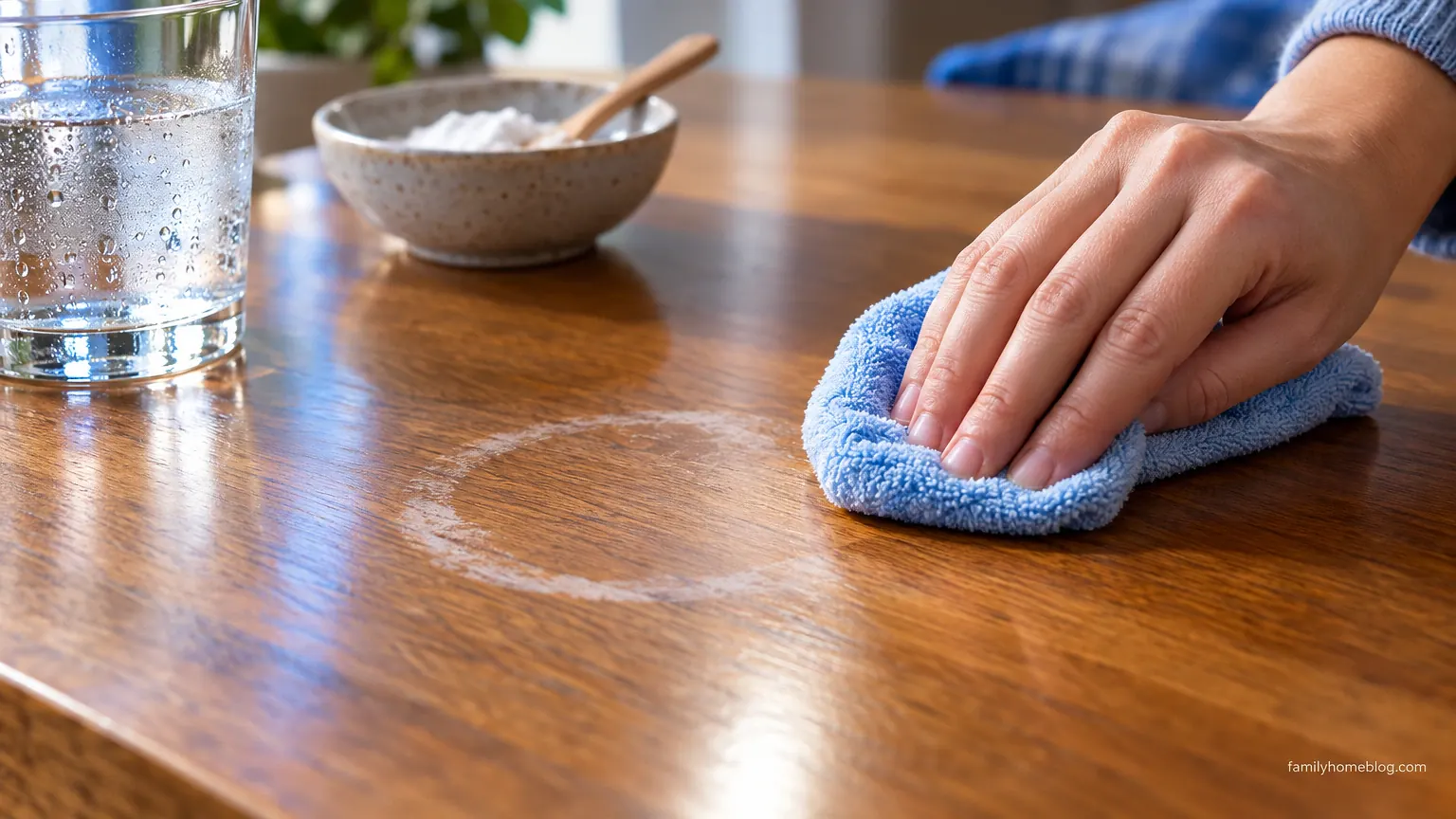
White rings on a tabletop are usually moisture trapped in the finish, not in the wood itself. Dark rings are different. They mean water reached the bare wood and reacted with its tannins. Most guides treat the two as one problem, and that is why so many attempts fail.
Start by identifying which you have. Then match the method to the stain, and stop the moment it fades.
Tell white rings from dark stains first
Press a fingertip on the ring and look at its color. A white or cloudy ring sits in the finish layer. A gray, black, or deep brown stain has gone through the finish into the wood fibers.
Test the finish before you treat anything. Rub a drop of mineral spirits on a hidden spot. If the finish turns tacky, it is likely shellac or lacquer, which are the finishes most prone to white rings. If nothing happens, you probably have a cured polyurethane or varnish, which resists most home methods.
| Stain look | Where the water sits | First method |
|---|---|---|
| White or cloudy ring | In the finish | Heat or mild abrasive |
| Gray or black ring | In the bare wood | Oxalic acid |
| Dark brown with raised grain | Wood and finish both damaged | Sand, then refinish |
Lift white rings with a cotton cloth and an iron
Heat lets trapped moisture evaporate out of the finish. This works best on shellac and lacquer, and it costs nothing.
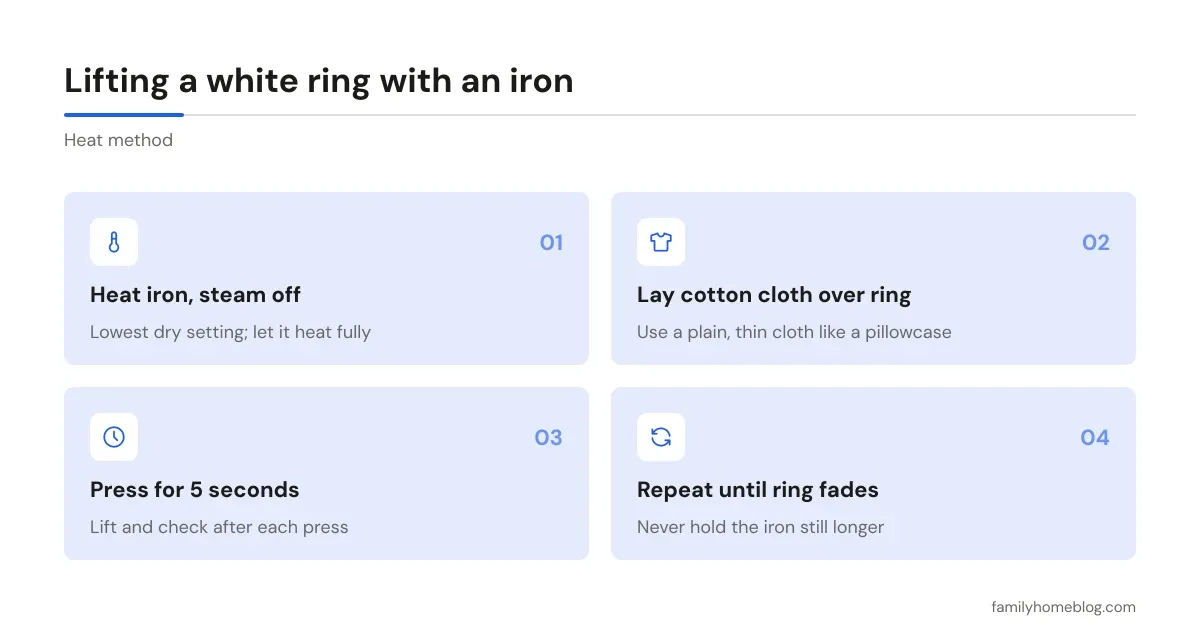
- Set an iron to its lowest dry setting, with steam off. Let it heat fully.
- Lay a plain, thin cotton cloth, such as a pillowcase or t-shirt, flat over the ring.
- Press the iron on the cloth for 5 seconds. Lift and check.
- Repeat in 5-second bursts until the white fades. Never hold the iron still for longer.
A hair dryer on its hottest setting works for light rings. Hold it 4 to 6 inches from the surface and move it slowly for about a minute.
This method can soften a finish and leave a dull or sticky patch. It does nothing for dark stains. If the ring is still there after three or four rounds, the water is not just in the finish. Move on to the next method rather than adding more heat.
Try a mild abrasive if heat does not work
When heat fails, the ring is often sealed in a thin film of finish. A very gentle abrasive can buff it away.
Squeeze a pea-sized dab of non-gel white toothpaste onto a soft cloth. Rub with the grain, never across it, using light pressure for about 30 seconds. Wipe clean with a damp cloth and dry immediately. Mayonnaise left on the ring for an hour is the old household alternative, but toothpaste is easier to control.
Skip gel toothpaste and anything with whitening beads. Those scratch the finish and create a new problem larger than the ring. Wax or polish the spot afterward so the buffed area matches the rest.
Remove dark stains with oxalic acid
Gray and black stains need a bleach that works on wood tannins, not household chlorine bleach. Oxalic acid, sold as wood bleach at hardware stores, is the standard choice. It is toxic and corrosive, so read the label and follow it.
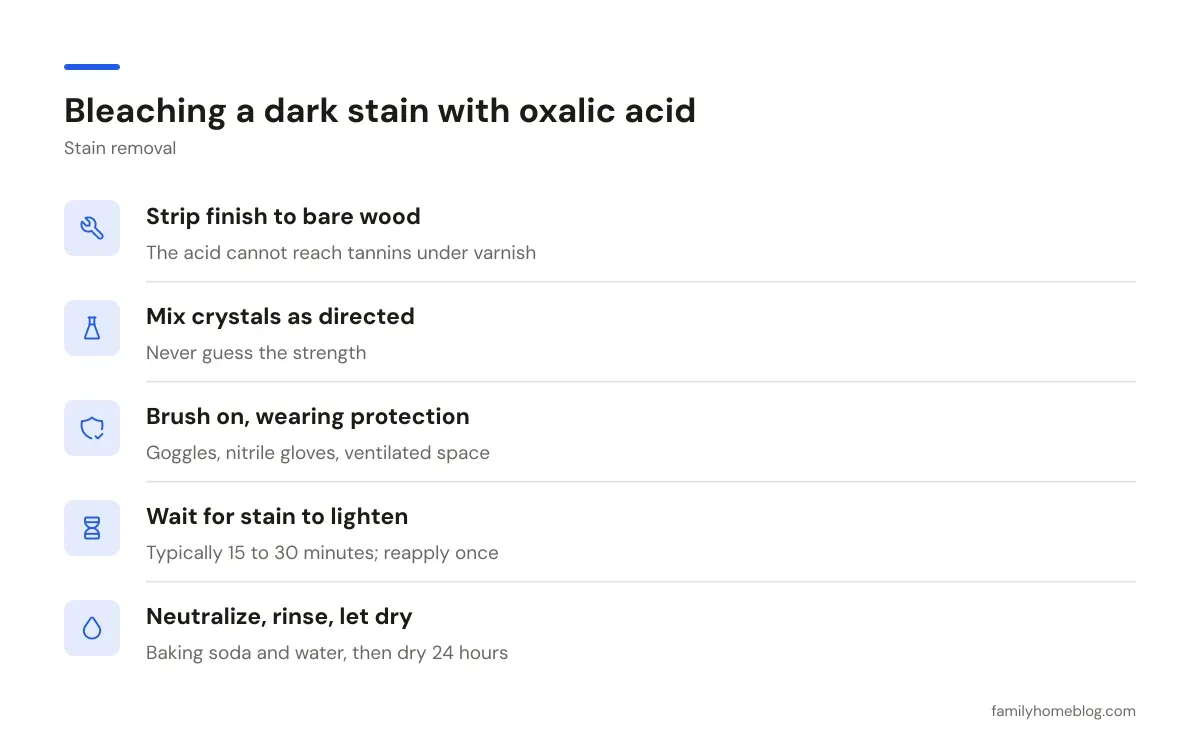
The Forest Products Laboratory, the USDA’s wood research arm, documents oxalic acid as the treatment for water and iron stains on wood. The steps below follow that general approach.
- Strip the finish over the stain with a chemical stripper or by sanding to bare wood. The acid cannot reach tannins under varnish.
- Mix oxalic acid crystals into warm water at the ratio printed on the package. Never guess the strength.
- Wearing chemical splash goggles and nitrile gloves, brush the solution on the stain. Work in a ventilated space.
- Let it sit until the stain lightens, typically 15 to 30 minutes. Reapply once if needed.
- Neutralize with a mixture of 1 tablespoon baking soda per cup of water, then rinse with clean water and let the wood dry for 24 hours.
Do not mix oxalic acid with chlorine bleach or ammonia. Combining cleaning chemicals can release toxic gas, and the CDC lists bleach and ammonia together as a hazard. Keep each product in its own step, with a full rinse between.
Know the surfaces that will not tolerate these methods
Veneer is the biggest trap. It is a layer often thinner than 1/40 inch, and the iron method can melt the glue beneath it, causing bubbling. Sanding or acid can cut straight through it. If a piece is veneered, stay with the lightest method and test it first.
Oiled and waxed finishes behave differently. Heat can pull oil to the surface and leave a darker patch. Wipe the area with a little mineral oil and fresh wax instead.
Antiques are the other exception. Sanding or bleaching a valuable piece can erase thousands of dollars in value in minutes. Stop and ask a furniture conservator before treating anything old.
When the stain stays: sand and refinish the spot
Some stains go deep enough that no surface method will lift them. Raised grain, black rot-like discoloration, or a stain that darkens after bleaching all point here.
Sand lightly with 150-grit paper, moving with the grain, until the discoloration is gone. Follow with 220-grit to smooth. Wipe off the dust with a tack cloth, then match the original finish. A tinted wipe-on polyurethane is forgiving for small repairs, and two to three thin coats blend better than one thick coat.
If the wood has gone soft or crumbly, that is rot, not a stain. Rot means a moisture source is still active, often a leak. Fix the leak first, and call a pro if the damage spreads beyond a small patch.
Next time, put a coaster under every glass and wipe spills within a few minutes. A fresh white ring is far easier to lift than one that has had a week to set.
Frequently asked questions
Does hydrogen peroxide remove water stains from wood?
It can lighten mild dark stains on bare wood, but it is weaker than oxalic acid and does little on finished surfaces. Test on a hidden area first, since it can lighten the surrounding wood unevenly.
Why did my water stain get darker after I treated it?
You likely pushed more moisture into the wood or heated tannins already present. Stop, let the wood dry fully for a day, and switch to oxalic acid on bare wood rather than repeating the first method.
Can I use vinegar on a water stain?
White vinegar diluted in equal parts water may lift very light rings, but the acid can dull some finishes. Wipe dry at once and never use it on waxed or oiled surfaces.
How long does a water stain take to become permanent?
There is no fixed deadline, but stains left for weeks tend to reach the bare wood and darken. Treating a white ring within a day or two gives the best odds of simple removal.