

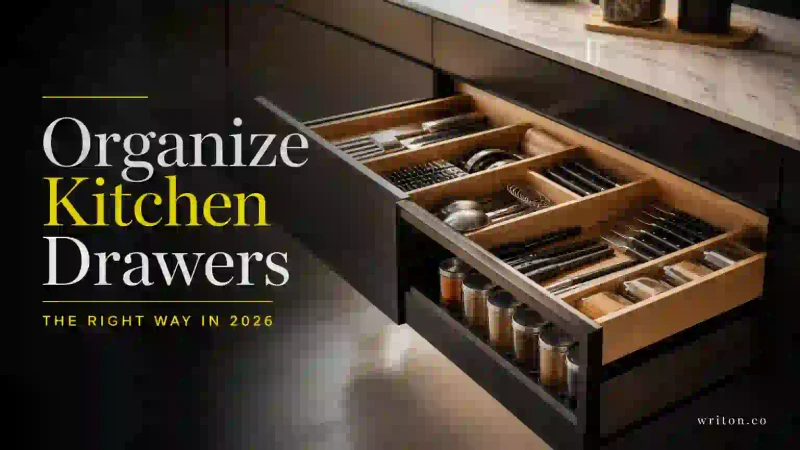
Most kitchen drawer advice gets one thing fundamentally wrong: it focuses on buying more organizers before understanding how the drawer actually gets used. The result is a tidy-looking setup that falls apart within two weeks.
Real organization starts with behavior, not bins. Once you understand which items you reach for daily versus occasionally, the right layout becomes obvious – and the whole system stays intact without constant maintenance.
The Problem With Most Drawer Organization Attempts
Randomly tossing in a bamboo divider grid is not a system. It is wishful thinking. The average American kitchen has between 4 and 8 drawers, yet most households use fewer than half that space efficiently, according to kitchen design professionals who survey clients before renovation projects.
The core issue is that people organize for how they think they cook, not how they actually cook. Spatulas end up in a “cooking tools” drawer that sits 18 inches from the stove, while the one spatula used daily stays on the counter because the drawer is inconvenient. That gap between intent and habit kills every organization attempt before it starts.
Fix the behavior map first. Spend two days cooking normally and notice which tools you grab without thinking. Those items belong in the drawer closest to their point of use, even if that means breaking conventional “category” logic.
Step-by-Step Method for Sorting What You Actually Own
Before buying a single insert, do a full drawer audit. This process takes about 30 minutes and makes every subsequent decision easier.
- Pull every drawer completely out and set contents on the counter.
- Group items into three piles: daily use, weekly use, and rarely used.
- Measure each drawer’s interior width, depth, and height – write these down. A standard kitchen drawer is typically 21 inches deep and 15–18 inches wide, but yours may differ by several inches.
- Discard or donate duplicates. Most kitchens have 3 to 5 redundant peelers, corkscrews, or can openers hiding in the back.
- Assign each pile to a drawer location based on proximity to use: daily items near the stove or prep area, weekly items in mid-range drawers, rarely used items in the farthest or lowest drawer.
This step alone – before any product purchase – produces a measurable result. Most people reduce their drawer contents by 20 to 30 percent just from removing duplicates.
The Best Drawer Organizers Worth Buying in 2026
Not every insert is worth the shelf space it came from. After testing options across different drawer sizes, a few categories stand out.
- Bamboo expandable dividers (brands like Lipper International or similar) – adjust from 11 to 17 inches wide, fit most standard drawers, cost $12–$25, and hold up well to moisture
- Acrylic modular trays – stackable, easy to clean, visible from above, typically $20–$45 for a 5-piece set; best for utensil and gadget drawers
- Foam drawer liners – non-slip base layer, cut to size, prevent items from sliding; runs $8–$15 per roll covering roughly 10 linear feet
- Knife drawer inserts – slotted wood or plastic blocks that sit inside a drawer instead of on the counter; keep blades protected and fingers safe; typically $18–$35
- Pegboard-style adjustable inserts – peg holes let you reconfigure compartment sizes without buying new hardware; excellent for utensil drawers with oddly shaped tools
> Pro tip: Measure your drawer interior before ordering any organizer online. Even a 0.5-inch difference can prevent a tray from fitting flush, which causes the entire insert to shift every time the drawer opens.
Assigning the Right Drawer to the Right Category
Proximity is the single most important principle in kitchen drawer organization. It beats aesthetics every time. A drawer that sits 24 inches from the stove should hold cooking tools. A drawer next to the sink belongs to dish towels and cleaning brushes. The junk drawer – yes, keep one – should be near the main entry point of the kitchen, not buried in a corner.
Here is a practical assignment framework most professional organizers use:
- Drawer 1 (nearest stove): spatulas, tongs, wooden spoons, ladles – the daily cooking tools
- Drawer 2 (prep area): knives in a slotted insert, vegetable peeler, box grater, thermometer
- Drawer 3 (near sink): dish towels, cleaning cloths, small brushes
- Drawer 4 (mid-kitchen): measuring cups, measuring spoons, baking tools used weekly
- Drawer 5+ (far or low): rarely used gadgets, takeout menus, batteries, the designated junk drawer
This framework reduces the number of steps you take during cooking by an estimated 15 to 25 percent – a real efficiency gain that compounds over hundreds of meals per year.
Why Vertical Space Inside Drawers Gets Ignored
Standard drawer inserts are flat. That works fine for utensils, but it wastes the 3 to 4 inches of vertical clearance most kitchen drawers have above a single-layer tray. Stackable inserts, riser platforms, and two-tier organizers use that vertical space effectively.
OXO makes a two-tier utensil organizer that fits drawers as shallow as 2.5 inches deep and holds nearly double the items of a flat tray. For spice packets, sauce packets, or small bags stored in a drawer, a shallow riser keeps them visible and accessible instead of buried under a pile. This one adjustment can double the effective storage capacity of a single drawer without touching any other drawer in the kitchen.
Maintaining the System After the First Week
Organization collapses when it requires effort to maintain. The best systems are self-enforcing: every item has one spot, and returning it there takes no more effort than tossing it somewhere random.
Two habits make the difference. First, do a 2-minute drawer reset every evening – not a deep clean, just returning anything that drifted. Second, do a quarterly review (roughly every 90 days) where you reassess which tools are actually being used. Cooking habits shift with seasons and new recipes, and your drawer layout should shift with them.
If a drawer starts accumulating random items that don’t belong, that is a signal – not a failure. It usually means one category lacks a dedicated home. Add a small tray or reassign a drawer rather than letting the overflow continue.
Common Mistakes That Undo Good Organization
Even a well-planned kitchen drawer setup breaks down for predictable reasons. The most common: overfilling. A drawer should be no more than 70 to 75 percent full. When items are packed edge to edge, people stop returning things properly because it requires too much effort to fit everything back in.
Second mistake: ignoring drawer depth. Shallow drawers (under 2 inches deep) cannot hold standard utensil trays and need purpose-built shallow inserts or simple non-slip liners instead. Forcing a 3-inch tray into a 1.75-inch drawer means the drawer will not close – a frustrating problem that could have been avoided with one measurement before purchase.
Third mistake: organizing everything at once in a single afternoon, then never revisiting it. A kitchen is a living space. What works in January may not work in July when grilling tools rotate in and baking equipment rotates out.
A Tidy Drawer Is a Kitchen That Works Faster
Getting drawer organization right has a real payoff. Cooks who can locate any tool within 3 seconds spend more time actually cooking and less time hunting through cluttered spaces. That is not a small quality-of-life improvement – over a year of daily cooking, it adds up to hours recovered.
The approach that works is simple: audit before buying, assign by proximity, use the right insert for each drawer’s specific dimensions, and build in a short maintenance habit. No single product fixes a disorganized kitchen. But the right combination of measurement, assignment logic, and consistent upkeep does.
If you are starting from scratch, begin with just one drawer – the one nearest the stove. Get that right, and the rest of the kitchen follows naturally. Small wins build momentum faster than trying to overhaul everything in one session.
When you implement how to organize kitchen drawers, revisit the checklist above against your real constraints.
Frequently asked questions
How many drawer organizers do I actually need for a typical kitchen?
Most kitchens with 4 to 6 drawers need 2 to 3 organizer inserts at most. Not every drawer requires a structured tray – dish towel drawers and junk drawers often work fine with just a non-slip liner. Focus your organizer budget on the 2 drawers you open most often.
What is the best way to organize a kitchen junk drawer?
Keep it, but contain it. Use a simple divided tray with 4 to 6 compartments – batteries in one slot, pens in another, twist ties and rubber bands in a third. The goal is not perfection but findability. A contained junk drawer that takes 5 seconds to search is genuinely useful.
Should I use bamboo or acrylic drawer organizers?
Bamboo holds up better near heat and moisture, making it better suited for drawers near the stove or sink. Acrylic is easier to wipe clean and works well for gadget or baking drawers farther from water. Both are solid choices – the decision comes down to location, not aesthetics.
How do I organize kitchen drawers when I have very few of them?
Prioritize ruthlessly. With only 2 or 3 drawers, limit each to one tight category: daily cooking tools, prep tools, and one utility drawer. Move rarely used items to cabinet shelves or a small countertop crock. Vertical inserts and stackable trays help squeeze more function from limited space.
How often should I reorganize my kitchen drawers?
A full reorganization once or twice a year is plenty. The daily 2-minute reset and a quarterly check to reassign any displaced items keeps the system functional between those deeper sessions. Reorganizing too frequently is a sign the original layout does not match your actual cooking habits – fix the layout, not the frequency.


