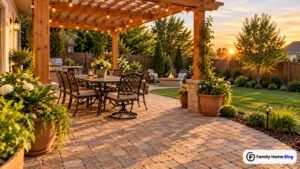
Above ground pool deck ideas range from a simple entry platform to a full wraparound deck with built-in benches and two sets of stairs. Which one makes sense for your yard depends on your budget, how your lot slopes, and how many people use the pool at once. A full wraparound deck typically runs $4,700 to $7,800, according to Trex’s above-ground pool deck cost guide, while a small entry platform costs far less. Before you settle on a layout or a decking material, though, pool barrier codes, gate hardware, and electrical clearance rules shape what you’re allowed to build. This guide walks through real design options, current material costs, the safety rules that apply to almost every above ground pool, and the mistakes that trip up first-time builders.
How much does an above ground pool deck cost?
A full above ground pool deck typically costs $4,700 to $7,800 for a wraparound design, according to Trex’s above-ground pool deck cost guide. Material choice swings that number the most: wood decking runs $25 to $70 per square foot installed, composite runs $40 to $80 per square foot, and PVC or plastic decking runs $8 to $13 per square foot, all figures from HomeAdvisor’s pool deck cost data.
Size, region, and labor add more variation. A small entry platform might cost a few hundred dollars in lumber if you build it yourself, while a two-level deck with railings, stairs on both sides, and built-in seating for a large pool can run well past that wraparound average once you add professional labor. Get at least three local quotes before you commit to a material, since regional lumber and labor costs vary from one area to the next.
Worth knowing up front
- A full wraparound above ground pool deck typically costs $4,700 to $7,800, per Trex’s cost guide.
- Most codes require a barrier at least 48 inches tall with no opening wide enough for a 4-inch sphere.
- Gates must swing away from the pool and be self-closing and self-latching, per Pima County, Arizona’s pool barrier code.
- Composite decking runs $40 to $80 per square foot installed, roughly double plastic decking at $8 to $13, per HomeAdvisor.
- Any outlet within 20 feet of the pool needs GFCI protection, and bonding work belongs to a licensed electrician.
Do you need a fence around an above ground pool?
Yes, in nearly every U.S. jurisdiction you need a compliant barrier around a pool, and an above ground pool’s wall can serve as part of that barrier if it meets height and access rules. Pima County, Arizona’s residential pool code, typical of many local ordinances, requires the top of the barrier to sit at least 48 inches above grade, measured on the side away from the pool, with no gap large enough for a 4-inch sphere to pass through.
The pool wall itself must be at least 48 inches tall to count as a barrier, and any ladder or steps used to climb in have to be capable of being secured, locked, or removed when the pool isn’t supervised. Gates in the barrier must swing outward, away from the pool, and be self-closing and self-latching, with the release mechanism positioned so a small child can’t reach it from outside. Because these numbers vary by state and county, confirm the exact height and setback your inspector will enforce before you finalize your above ground pool deck ideas. For related outdoor fencing options, see this guide on upgrading your property with fencing.
Above ground pool deck ideas: which materials work best around water?
Material choice affects both the look of your deck and how it holds up to constant splashing. Four options cover most builds: pressure-treated or hardwood lumber, composite boards, PVC or plastic decking, and concrete pavers used as a ground-level surround.
| Material | Installed cost per sq ft | Pros | Cons |
|---|---|---|---|
| Pressure-treated or hardwood lumber | $25–$70 | Familiar look, easy to repair board by board | Needs yearly sealing; can splinter and warp near water |
| Composite decking | $40–$80 | Resists rot and fading; low maintenance | Highest upfront cost; can get hot in direct sun |
| PVC or plastic decking | $8–$13 | Budget-friendly; fully waterproof | Can feel slippery when wet; may fade or crack in cold climates |
| Concrete pavers (ground-level surround) | $3–$7 | Very durable; wide style range | Not usable for an elevated deck; needs a compacted base |
For a deeper look at synthetic options, this composite decking board comparison and this eco-friendly decking materials guide cover the trade-offs in more depth. For the surface closest to the water and the ladder, pick a board with a textured or grooved finish; HomeAdvisor’s pool deck data notes that glossy PVC decking can get slippery when splashed, which matters most on the two or three boards right at the pool entry.
How do you plan and build an above ground pool deck step by step?
Most above ground pool deck ideas follow the same build sequence, whether you’re adding a small platform or a full wraparound deck.
- Check your local permit and setback rules first, since pool decks usually fall under the same review as the pool barrier.
- Call 811 to have underground utility lines marked before you dig any footings.
- Sketch the layout and, if the deck will attach to the pool wall, ask a contractor whether the frame needs separate structural support; above ground pool walls aren’t rated to carry deck loads.
- Set footings below your area’s frost line; a licensed contractor or your permit office can confirm that depth for your zip code.
- Frame the deck and install slip-resistant decking, spacing boards per the manufacturer’s instructions for drainage.
- Add code-compliant railings and a self-closing, self-latching gate before the pool goes into use.
- Schedule your final inspection; most jurisdictions require sign-off on the barrier before you fill the pool.
What common above ground pool deck mistakes should you avoid?
- Skipping the permit because the pool itself is temporary; most localities still require a barrier permit for the deck and gate.
- Bolting deck framing directly to the pool’s top rail without confirming it can bear that load, since above ground pool walls are built to hold water pressure, not deck weight.
- Installing a gate that swings toward the pool or that latches by hand instead of automatically.
- Choosing smooth or glossy boards for the steps and entry area, where wet feet need traction most.
- Setting footings too shallow, which lets the deck heave or settle within a season or two.
- Running an extension cord to a pool pump instead of installing a GFCI-protected outlet within code distance.
Do you need a permit for an above ground pool deck?
In most areas, yes. An above ground pool deck almost always needs a building permit, both for the structure itself and for sign-off on the required pool barrier and gate. Some cities exempt small, unattached platforms below a certain height, but once a deck wraps around a pool and ties into the barrier, it typically falls under full review.
Contact your local building department before you buy materials. Ask specifically whether your county follows a pool-specific ordinance or a general deck code, since the barrier height, gate hardware, and setback numbers can differ from the rules your neighbor’s ground-level deck followed.
Electrical and drowning safety around your above ground pool
Any electrical work near an above ground pool needs to meet strict clearance rules, and the safety stakes go beyond code compliance. The National Electrical Code requires GFCI protection on any 15- or 20-amp, 125-volt receptacle within 20 feet of a storable or above ground pool, covering the outlet you’ll likely use for the pump and any pool lighting. Metal ladders, rails, and pump housings near the water may also need bonding to reduce shock risk. Never attempt bonding or new circuit work yourself; hire a licensed electrician, since a wiring mistake near standing water is one of the few home-improvement errors that can be dangerous immediately, not just costly to fix later.
The stakes are real for families with young kids specifically. CPSC’s 2026 drowning report found that children under 15 died in pool- or spa-related incidents at an average rate of 376 per year between 2021 and 2023, and nearly 80 percent of those deaths were children under age five. Over 70 percent of the incidents happened at a home, whether the victim’s own, a relative’s, or a neighbor’s. That’s the core reason barrier height, self-closing gates, and secured ladders aren’t optional extras on your above ground pool deck ideas; they’re the layer of protection between an unsupervised toddler and the water.
When this stops being a DIY job
Some parts of an above ground pool deck project are fine for a confident DIYer; others aren’t. Call a licensed electrician for any new circuit, GFCI installation, or bonding work near the pool, and never run temporary cords or attempt wiring modifications yourself. Bring in a structural or deck contractor if you’re attaching framing to the pool’s top rail, building a multi-level deck, or working on a slope, since footing depth and load paths need to be engineered correctly. A local pool or fence installer can also confirm that your gate hardware meets the exact height and latch requirements your inspector will check, which saves a failed inspection later. Once the structure is safe and code-compliant, a set of patio furniture for your deck or a look at comparing pool types can help you finish the space.
Questions homeowners ask
Do I need a permit for a ground-level deck?
Often yes, though rules vary more for ground-level structures than elevated ones. Many jurisdictions exempt decks under a certain size and height above grade, but once the structure surrounds a pool and connects to the required safety barrier, most building departments treat it as a full permit project. Check with your local building department before assuming a low deck around your pool is exempt, since pool-specific rules frequently override the general deck exemption.
What are the code requirements for an above ground pool deck gate?
Gates in a pool barrier must swing away from the pool and close and latch on their own, without anyone touching them. Pima County’s residential pool code, similar to rules in many states, requires the latch release to sit high enough or be shielded so a small child can’t reach it from outside the enclosure, and any gap around the gate must be too narrow for a 4-inch sphere to pass through.
How do you design and build an above-ground pool deck?
Start with your local permit office to confirm barrier, gate, and setback rules, then sketch a layout that matches your yard’s shape, whether that’s a full wraparound, a partial deck on one side, or just an entry platform. From there, set footings below the frost line, frame the structure, install slip-resistant decking, and finish with a code-compliant railing and self-closing gate before you fill the pool.
What size deck can I build without a permit?
The exempt size differs by city and county, so there’s no single national number. Many places exempt small, low platforms that aren’t attached to the house, but a deck built around an above ground pool usually needs a permit regardless of size, because it ties into the required pool barrier and gate rules. Confirm the exact threshold with your local building department before you start buying lumber.
Which children are most at risk of drowning in a pool?
Children under five face the highest risk by far. CPSC’s most recent drowning report found that nearly 80 percent of fatal pool and spa drownings among children under 15 involved kids younger than five, and more than 70 percent of these incidents happened at a residence between 2021 and 2023. That’s why a compliant barrier, a self-closing gate, and constant supervision matter most in the toddler years.
Start your above ground pool deck ideas with a call to your local building department, not a materials list. Once you know your barrier height, gate rules, and setback, you can compare wood, composite, PVC, and paver costs against your actual budget instead of a national average. Get quotes from at least two contractors if you’re attaching framing to the pool wall or wiring a new GFCI circuit, since both jobs carry real safety consequences when done wrong. A weekend spent confirming code details saves you a failed inspection, or worse, later in the season.